
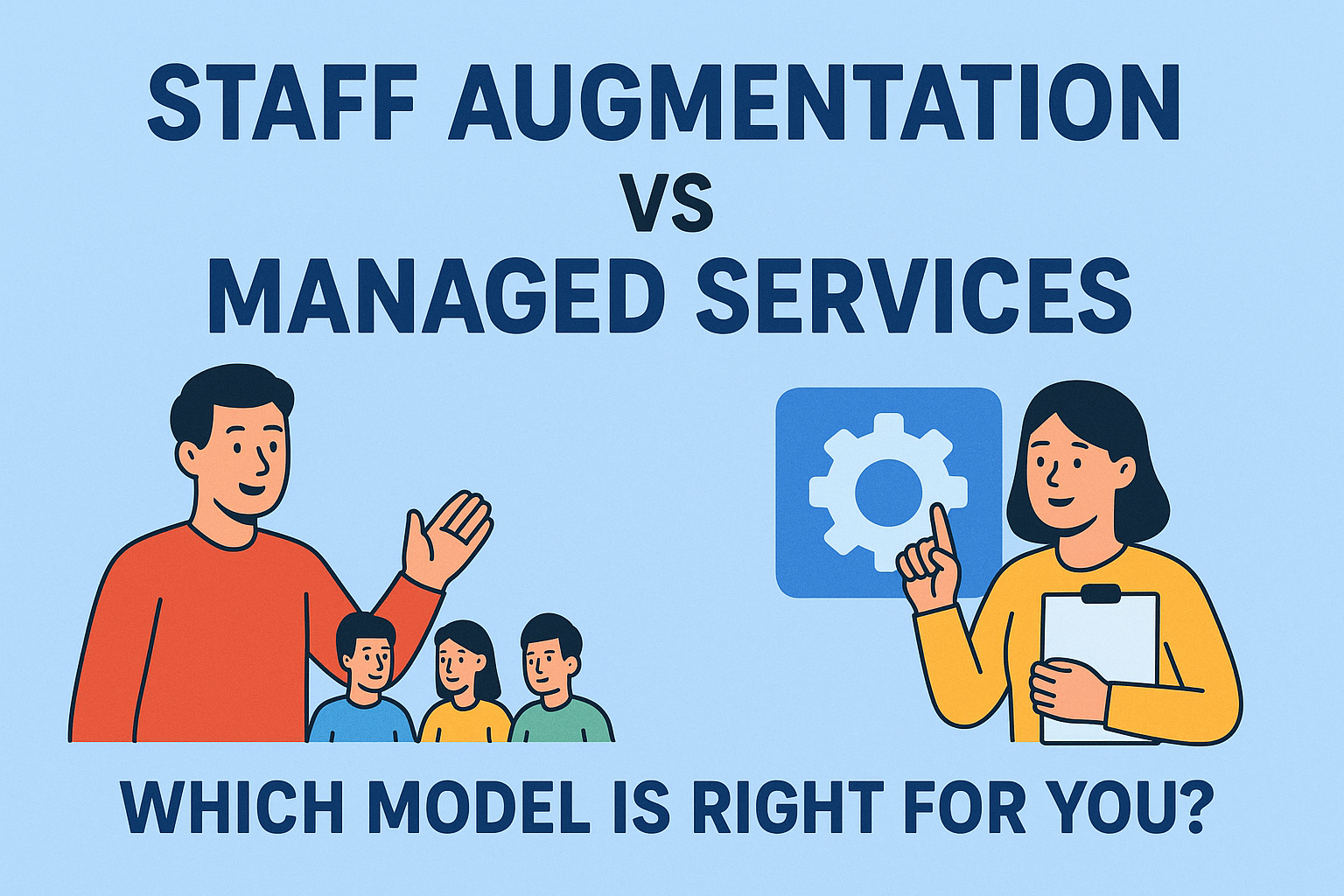

Staff Augmentation vs Managed Services: Which Model Is Right for You?
🏁 1. Introduction: Staff Augmentation vs Managed Services
Imagine you’re building a school project. Sometimes you need extra hands. Sometimes you want someone else to handle the whole project for you.
That’s exactly what “staff augmentation vs managed services” means for companies.
-
Staff Augmentation = “I want extra helpers who work with me.”
-
Managed Services = “I want someone who takes care of the whole problem for me.”
In this blog, we’ll help you choose the right model using simple examples, fun stories, and easy steps.
🧠 2. Key Concepts & Definitions
⭐ Staff Augmentation
This means you hire extra people to join your team for a short time.
Think like this:
Your school needs more teachers for exam time. So they bring in temporary teachers. They follow your school rules and work with your teachers.
In business:
-
You already have a team.
-
You only need more people to finish the job.
-
You stay in control of the project.
⭐ Managed Services
This means you give the whole job to another team, and they take care of everything.
Think like this:
Your school wants a new computer lab. Instead of doing it themselves, they hire another company to plan, install, and maintain everything.
In business:
-
You don’t want to manage the work.
-
You want experts to handle everything.
-
They decide how the work happens.
3. Step-by-Step Framework to Choose the Right Model
Step 1: Ask “Do I have my own team?”
-
YES ➡ Staff augmentation may work.
-
NO ➡ Managed services may be better.
Step 2: Ask “Do I want to control the work?”
-
YES ➡ Staff augmentation.
-
NO ➡ Managed services.
Step 3: Ask “How big is the project?”
-
Small or medium ➡ Staff augmentation.
-
Big and long-term ➡ Managed services.
Step 4: Ask “Do I want responsibility or relief?”
-
Responsibility = staff augmentation.
-
Relief = managed services.
⚒️ 4. Tools, Techniques & Best Practices
⭐ Best Tools Used in Both Models
-
Project tracking apps
-
Trello
-
Asana
-
Jira
-
-
Communication tools
-
Slack
-
Zoom
-
-
Time tracking
-
Clockify
-
Hubstaff
-
⭐ Best Practices
-
Set clear goals
-
Create simple checklists
-
Have weekly meetings
-
Share updates in writing
-
Use dashboards to track work
❌ 5. Common Mistakes & How to Avoid Them
Mistake 1: Choosing without thinking
Fix: Use the Step-by-Step Framework above.
Mistake 2: Not checking skills
Fix: Always test people before hiring.
Mistake 3: Expecting too much from small teams
Fix: Match project size with the right model.
Mistake 4: No communication
Fix: Use weekly calls + clear notes.
📚 6. Case Studies / Real-Life Examples
🧩 Example 1: Staff Augmentation
Rahul’s company was building an app. His team was good, but slow.
So he hired two extra developers for 3 months.
They worked under Rahul and helped finish the app faster.
Why it worked:
Rahul already had a team. He only needed more hands.
🧩 Example 2: Managed Services
A school wanted an online fee payment system.
They had no tech team.
So they hired a company to build and run the whole system.
Why it worked:
The school had no team. They wanted stress-free service.
📝7. Action Plan / Recommendations
✔ If you want more people but still want control ➡ Choose Staff Augmentation
✔ If you want someone to handle everything ➡ Choose Managed Services
Quick Quiz (Just for fun!)
-
You need 2 designers for 1 month ➡ Staff Augmentation
-
You want someone to manage all IT support for a year ➡ Managed Services
🏆 8. Conclusion
Choosing between staff augmentation vs managed services is simple when you think like a kid planning a school project.
Do you want helpers or complete service?
Once you know that, picking the right model becomes super easy!
❓ FAQs (Simple Answers!)
1. What is the main difference?
Staff augmentation = extra people.
Managed services = full service.
2. Which is cheaper?
For small tasks → staff augmentation.
For long-term support → managed services often costs less.
3. Which model is faster?
Managed services is faster for big jobs.
Staff augmentation is faster for small jobs.
4. Do both work for IT projects?
Yes! Both are common in IT companies.
5. Can small businesses use these models?
Yes. Even small shops or startups use both.
Leave a Reply